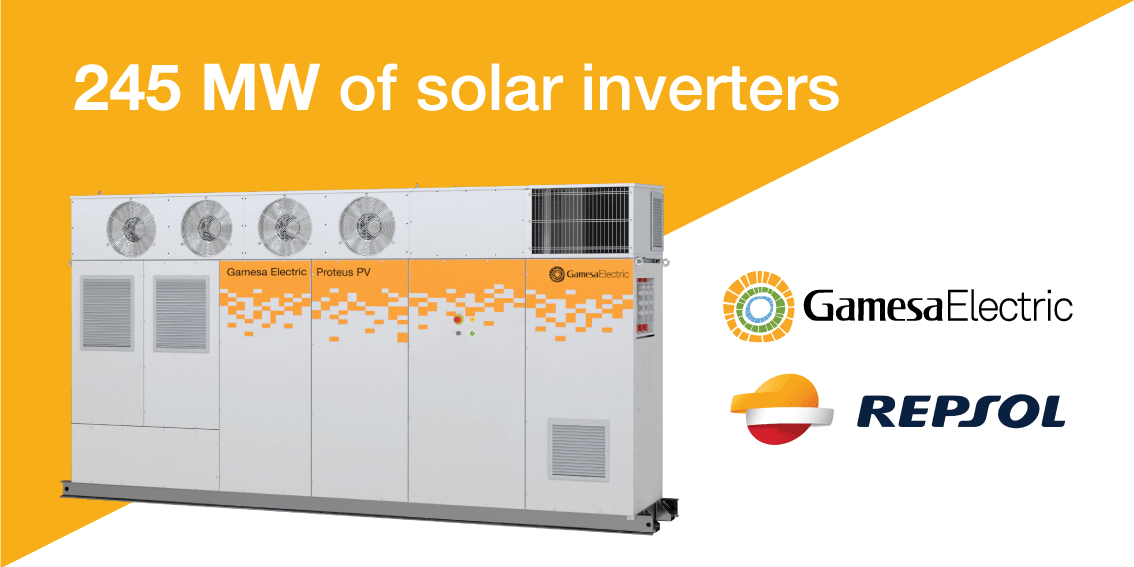
- The projects are located in Spain.
- The supply includes Gamesa Electric Proteus PV inverters together with the Gamesa Electric Orchestra plant controller
Gamesa Electric has signed an agreement with Repsol to supply Proteus PV inverters to solar PV plants that the multi-energy company is developing in Spain.
Specifically, the supply comprises a total of 30 units of Proteus PV Station 9000 and 4 units of Proteus PV Station 4500 for a total of 64 Proteus PV inverters together with 3 Gamesa Electric Orchestra plant controllers.
“We are very pleased to continue our collaboration with Repsol with these PV projects,” said Juan Barandiaran, CEO of Gamesa Electric. “This agreement is a further demonstration of how competitive the Proteus inverter is in large-scale projects. They are inverters with a power of up to 4700 kVA per unit, reaching up to plug&play solutions of 9400 kVA in medium voltage. With such high power ratings, it is possible to reduce the number of units and therefore optimize the LCoE of the project. In addition, record efficiency levels of 99.4% and reduced harmonic distortion make the performance of Proteus solutions optimal.”
Power, efficiency and reliability
The Gamesa Electric Proteus PV inverter achieves one of the highest power densities in the market, which allows to supply a complete PV station (Proteus PV Station 9400), including MV transformer and switchgear up to 9.4 MVA in a standard 40-foot structure, resulting in a plug&play solution.
The high-power rating together with a compact design and outstanding electrical efficiency values lead to significant improvements in LCoE, thanks first to the reduction of the number of inverter station units per project and thus to cost savings in logistics, construction, cabling, commissioning and maintenance. On the other hand, the higher efficiency values result in higher energy production at the solar plant level. If we add to this its harmonic distortion level (THD) below 0.7%, which reduces losses and increases reliability, we obtain a significant reduction in the final LCoE of the project.